
What Outsourced Business Development Actually Looks Like Week by Week | Zenith Partners
What good outsourced BD actually looks like week by week
Most people commissioning outsourced BD for the first time have the same question: what am I actually paying for?
It is a reasonable question. BD work is not always visible. Unlike advertising, there is no creative to approve. Unlike a consultant, there is no report on your desk at the end of the month. The activity is happening in calls, emails and conversations you were not part of, with contacts you may not know yet.
This article is a plain account of what a good outsourced BD team does each week, what outputs you should expect, and how to tell whether the work is on track.
What outsourced BD is not
Before going further, it helps to clear up a common misconception.
Outsourced BD is not a shortcut to a full pipeline. It is not a team that takes your product brochure on Monday and books ten qualified meetings by Friday. That kind of promise should be treated with serious scepticism.
What outsourced BD actually does is take on the systematic, time-consuming work that most internal teams neglect or deprioritise: researching targets, building contact lists, writing and refining outreach, making calls, handling follow-up, attending early-stage meetings and keeping relationships warm over time.
Done well, it creates the conditions for your senior people to spend more time in qualified conversations and less time prospecting. That is the real value. Not magic meetings, but a steady, well-managed pipeline that your team can trust.
Before week one: the setup that most teams skip
Good outsourced BD does not start with outreach. It starts with intelligence.
Before any call is made, a good team will spend time understanding your product, your target segment, your competitors, and what your best existing customers have in common. They will review any research you already have, ask questions about what has and has not worked before, and form a clear hypothesis about which accounts to prioritise and what message to lead with.
If your BD partner skips this stage and jumps straight into calling, the first few weeks will be wasted on contacts who are a poor fit or messaging that does not land. Setup is not overhead. It is the thing that makes everything after it more effective.
Specifically, a good setup phase involves:
Defining your ideal client profile: company size, sector, role of the buyer, and what triggers make someone a priority right now.
Crafting a call script and email sequence tested against realistic objections, reviewed with you before it goes live.
Agreeing on a weekly reporting rhythm so you know exactly what is happening and when.
This setup typically takes one to two weeks. It is time worth spending.
Weeks one to four: building the foundation
The first month is about generating signal, not closing deals.
Your team is making its first wave of calls and sending its first outreach. They are learning which segments respond, which messages open doors, and which contacts are genuinely moveable. They are also making mistakes and correcting them. The script will need refining. Some segments will turn out to be harder than expected. Some contacts will say something in a call that opens up a better angle.
What you should be seeing in this period:
A clean, verified target list that has been worked through systematically.
A record of every call and contact attempted, not just the positive ones.
Initial responses, whether positive or pushbacks, that give you signal on what is working.
A first round of revised messaging based on real feedback from the market.
At least a handful of conversations that have shown genuine interest, even if they have not turned into meetings yet.
What you should not be expecting yet: a full pipeline of ready-to-close deals. Anyone who promises that in month one is either overselling or working in a very unusual market.
Weeks five to eight: the first real meetings
By the second month, you should start to see booked meetings with qualified contacts.
These will not all convert. Some will be exploratory conversations that go nowhere. That is normal. The value of the meeting is not just whether it closes. It is the information that comes back from it: what objections came up, what the contact's real situation is, what competing options they are considering, and whether the timing is right.
A good outsourced BD team attends these meetings alongside your technical or commercial person. They do not just hand over the contact and disappear. They are in the room, or on the call, because they need to stay close to the sales process to manage the follow-up effectively and to keep the relationship warm after the meeting ends.
What you should be seeing in this period:
A regular stream of booked first meetings, not necessarily many, but consistent.
Written notes after every meeting with a clear summary of what was discussed, what the contact's situation is, and the agreed next step.
Active follow-up on every open thread. Nothing should go cold without a deliberate decision to deprioritise it.
A weekly report that tells you how many contacts are at each stage: new, in conversation, meeting booked, meeting held, follow-up in progress.
Months three to six: where the pipeline matures
By month three, you should have a functioning pipeline with accounts at different stages.
This is where the real leverage of outsourced BD starts to show. Your team has now had enough conversations to know which segments convert fastest, which objections come up most often, and how to position your offer in a way that resonates with buyers in this specific market. They can use that knowledge to sharpen the ongoing outreach and prioritise the accounts with the highest probability of moving forward.
You should also be seeing the first real commercial outcomes. Not necessarily closed deals, because B2B sales cycles in Southeast Asia are rarely that short, but proposals out, second meetings happening, and relationships that are clearly progressing.
What good looks like at this stage:
A pipeline report you trust, with named accounts, real stages and realistic timelines.
A pattern in the data: which types of companies convert, at what size, in which sectors.
A feedback loop between what the BD team is hearing and how your commercial or product team responds. The intelligence the BD team generates should be feeding back into your messaging, pricing and product positioning.
An honest conversation about what is not working, not just what is. A good BD partner raises problems. They do not hide them in optimistic slide decks.
What a weekly update should look like
The weekly update is how you stay close to the work without micromanaging it.
A good weekly update is short, specific and honest. It should tell you:
How many new contacts were reached this week.
How many conversations happened, and what came out of them.
How many meetings were booked or attended.
What follow-ups are in progress and what the status is.
Any adjustments made to the approach and why.
What the plan is for the coming week.
What it should not be is a long narrative of activity designed to make the week look busy. Calls made means nothing without context. Meetings booked tells you more. Deals moved forward tells you most.
If you are not getting a structured weekly update, ask for one. If you ask and what comes back is vague or inconsistent, that is a signal worth paying attention to.
What the BD team needs from you
Outsourced BD works best when both sides are pulling in the same direction.
The BD team needs:
Clear guidance on your target segment and any accounts you want to prioritise or avoid.
Fast responses when a meeting is booked. A two-day delay in confirming a meeting can cool a warm contact.
Honest feedback after every meeting. What did the contact say? What is your read on whether they will move forward?
Access to relevant materials: pitch decks, case studies, pricing guidance, and anything that helps the team have a more informed conversation.
An open channel to raise concerns. If the team is seeing the same objection repeatedly, you need to know about it so you can decide how to respond.
The companies that get the best results from outsourced BD treat the external team as an extension of their own commercial function, not as a vendor they check in with once a week.
How long before you see results?
This varies significantly depending on the complexity of your product, the length of your sales cycle, and how well-prepared the market intelligence is going in.
A general guide:
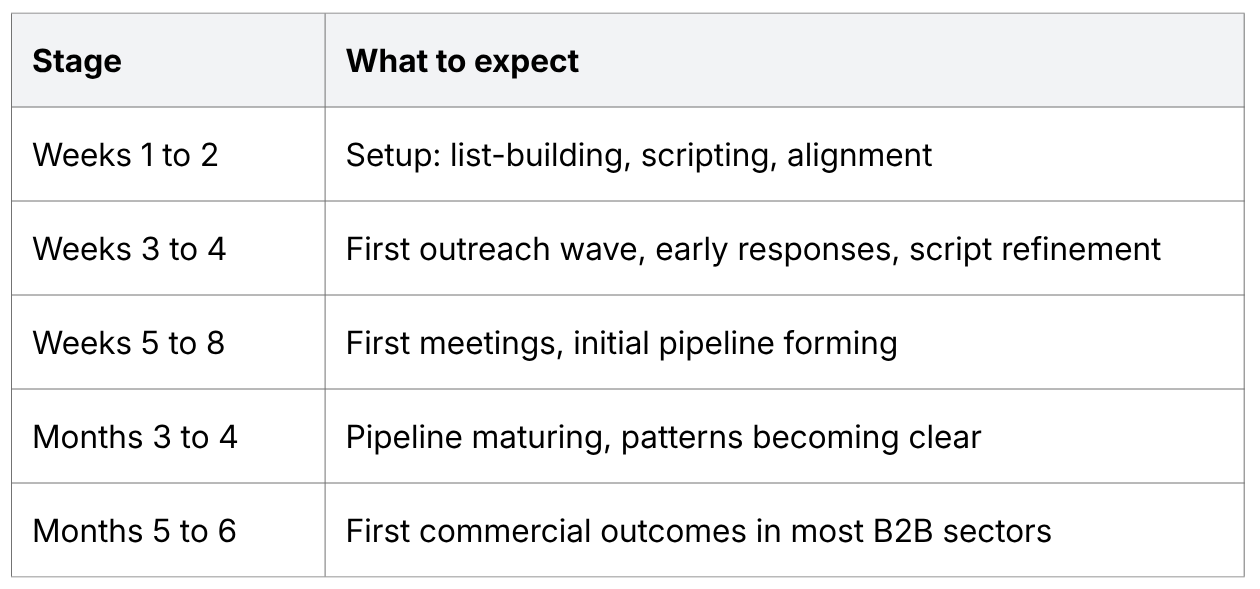
For complex, high-value B2B sales in Southeast Asia, six months is typically the minimum meaningful engagement period. A team that promises significant results in eight weeks is either working in a very simple sell or is not being honest about the cycle.
The role of market intelligence in making BD work faster
One of the most consistent patterns we see is that outsourced BD produces better results, faster, when it is built on top of real market intelligence.
Without intelligence, the BD team is working from assumptions. They do not know which accounts are likely to convert, which competitors those accounts are already using, or what objections to expect. They learn as they go, which costs time and money.
With intelligence in place before the outreach starts, the team knows which segments are most receptive, which messaging angles land, which accounts to prioritise, and what the competitive landscape looks like. The first calls are more targeted. The follow-up is more relevant. The meetings are more productive.
This is why at Zenith Partners, market intelligence and outsourced BD work together. The research does not just produce a report. It produces a starting point for the BD team that is weeks ahead of where a cold approach would be.
FAQ
What is the difference between outsourced BD and a lead generation agency?
A lead generation agency typically delivers contact lists or sets up initial meetings and then hands over. Outsourced BD covers the full early-stage commercial process: research, outreach, relationship management, meeting attendance and deal follow-up. The team stays involved rather than handing off after the first touch.
How is the outsourced BD team introduced to prospects?
Depending on the engagement model, the team can operate under your company's name, treating every interaction as if they are part of your internal team. This is the model that tends to work best for building trust with prospects in Southeast Asia.
What does it cost?
Outsourced BD is typically priced on a monthly retainer basis, pegged roughly to the cost of hiring one experienced BD person internally, plus commission on results. For most mid-market B2B clients, that sits in the range of USD 5,000 to USD 7,000 per month, with commission structures varying based on deal size and complexity.
Do I need market intelligence before starting BD?
You do not have to have it. But teams that start with solid intelligence consistently outperform teams that start cold. If you are entering a new market or targeting a segment you do not know well, doing the research first is time and money well spent.
What happens if the BD is not working after three months?
A good outsourced BD partner will surface this problem before you do. If the pipeline is not developing as expected, there should be an honest conversation about whether the issue is the outreach, the segment, the product-market fit, or something in the message. That analysis should be part of the engagement, not something you have to push for.
