
How to Do Market Entry Research in Southeast Asia: A B2B Guide | Zenith Partners
How to do market entry research properly: a step-by-step guide for B2B firms in Southeast Asia
Most companies research a new market the wrong way.
They pull some industry reports, ask their local contact a few questions, and present a set of assumptions to the board that nobody is really willing to challenge. The numbers look reasonable. The slide deck is tidy. And then they enter the market and discover that the reality on the ground is quite different from what the research suggested.
This guide is for B2B leaders who want to avoid that. It covers what good market entry research actually looks like, step by step, and what separates intelligence that is genuinely useful from information that just makes you feel better about a decision you had already made.
Step one: define your question before you define your market
The most common mistake is starting with the answer and working backwards.
A management team decides they want to enter Indonesia. The brief they give to whoever is running the research is effectively: find evidence that Indonesia is a good idea. The research will find that evidence, because the researcher is human and the mandate is implicit.
Good market entry research starts by being honest about what you do not know. Before you commission anything, write down the specific questions that, if answered clearly, would tell you whether to proceed and how.
Good questions sound like:
Is there real demand in this market for what we sell, at a price point that works for us?
Who are the two or three strongest competitors already serving this segment?
What are they charging, and how are buyers responding to that pricing?
What do buyers in this market care about most when choosing a vendor like us?
If you cannot write down your key questions clearly before the research starts, the research will not answer them.
Step two: understand what desk research can and cannot do
Desk research, meaning publicly available reports, industry databases, news articles, and competitor websites, has a place in any market entry process. It helps you orient yourself, understand the broad landscape, and identify the names of key players before you go any deeper.
But it has clear limits that most teams underestimate.
What desk research cannot tell you:
What competitors are actually charging. Their websites will show you positioning, not real pricing.
What buyers genuinely think. Published case studies and testimonials are curated.
Which partnerships are genuinely available. Trade directories tell you who exists, not who would work with you.
Why certain segments are harder to break into than others. That kind of nuance only surfaces through direct conversation.
A company listing services on their website does not mean they are actually delivering those services at the level described. Websites reflect aspiration as much as capability. Any market entry research that relies primarily on desk sources is working from a picture that has been deliberately managed by its subjects.
Desk research is the starting point. It is not the answer.
Step three: get out and talk to real people
The gap between desk research and market reality closes only through direct conversation. This means speaking with actual buyers, potential partners, competitors and industry contacts in the target market.
There is a right way and a wrong way to do this.
The wrong way is to call people as yourself, asking directly whether they would buy from you or partner with you. People will be polite. They will say positive things. They will not tell you that your pricing is too high, that your competitor is better embedded, or that the market you are targeting is already sewn up by two incumbents. They are not being dishonest. They simply have no reason to be that candid with a potential vendor who might be a future client, supplier or partner.
The right way is to approach the market from a neutral position, as a researcher conducting an industry study rather than as a vendor looking for business. This changes what people say, because they no longer feel they need to manage the conversation. They speak more freely about what they actually use, what they are unhappy with, what they wish existed, and what they think of the options available to them.
This is not a trick. It is simply good research methodology. The goal is to get information that is as accurate as possible, and neutrality is the tool that makes that possible.
Step four: talk to the right people
In Southeast Asia, the person who approves a purchase is often not the person who shortlists vendors. The person who knows the market best is often not in a formal directory. The competitor who is most threatening is often not the one with the most visible marketing.
Good market entry research requires mapping the right subjects before you start your outreach. That means thinking carefully about:
Buyers: not just senior decision-makers, but the people in the middle of the organisation who actually evaluate options and influence the shortlist.
Potential partners: not just the names in trade directories, but the smaller, less obvious operators who have strong relationships with the buyers you want to reach.
Competitors: including the regional players who do not have international profiles but who are deeply embedded with local buyers.
Industry contacts: people in trade associations, procurement roles, and adjacent businesses who can give you a view of the market that no single buyer or partner would have.
Reaching these people often requires access to trade association membership lists, government data, industry networks and shipping records. These are not publicly available in the same way a Google search is. Building or buying access to these sources is part of what separates thorough research from superficial research.
Step five: ask questions that reveal real behaviour, not stated preferences
There is a well-known gap between what people say they will do and what they actually do.
A buyer may tell you they would consider switching suppliers if the price were right. What they actually mean is that they have a strong relationship with their current supplier and would need a very compelling reason to disrupt it. The stated preference is flexibility. The real behaviour is loyalty.
Good research questions are designed to reveal actual behaviour rather than capture polite intentions. Instead of asking "would you consider using a product like ours?", you ask "who do you currently use, how did you select them, and what would need to change for you to consider an alternative?"
The second question is much harder to answer with a vague positive. It forces the respondent to be specific, and specific answers are where the real intelligence lives.
This requires expertise in questionnaire design. It is not a skill that comes naturally, and it is one of the clearest differences between research that produces useful findings and research that produces comfortable noise.
Step six: validate everything with source material
Any finding in a market entry research report should be traceable back to a source.
If the report says "buyers in this segment are dissatisfied with current supplier response times," there should be direct quotes or call recordings that support that claim. If it says "competitor pricing in this market ranges between X and Y," there should be documented conversations with buyers or channel contacts who confirmed those figures.
This matters for two reasons.
First, it allows you to calibrate confidence. A finding supported by eight separate conversations carries more weight than one supported by two. Source material lets you see that clearly.
Second, it protects you from a researcher who has filled gaps with assumptions. Any research team working without source transparency has more room to tell you what they think you want to hear. Source material is the accountability mechanism that keeps findings honest.
When you commission market entry research, always ask what source material will accompany the report. If the answer is unclear or dismissive, treat the findings with caution.
Step seven: separate market assessment from partner identification
These are two different outputs and they require different approaches.
Market assessment answers the question: is there a viable opportunity here for a firm like ours?
Partner identification answers the question: who specifically should we work with to pursue that opportunity?
Many research projects blur the two together, which weakens both. A proper market assessment requires understanding buyer behaviour, competitor positioning and demand dynamics. Partner identification requires a separate process of mapping the channel, contacting potential partners under neutral conditions, and evaluating their actual capability, commitment and fit.
The sequence matters too. You should complete the market assessment before you invest in partner identification. There is no point mapping the channel in detail for a market that the research reveals is not viable or not yet ready for your product.
Step eight: turn the research into an action list
The purpose of market entry research is not a report. It is a decision and a plan.
A good research deliverable does not end with conclusions. It ends with a clear set of actionable next steps:
A named list of potential partners, distributors or buyers that your sales team can contact, with background on each from the research.
A recommended entry sequence: which segment to approach first, which partner type to prioritise, which accounts to target in the first 90 days.
A pricing recommendation grounded in what the research revealed about buyer expectations and competitive benchmarks.
A messaging guide: what buyers in this market care about, how to frame your offer, and what objections to prepare for.
If the research ends with a summary of findings and a list of recommendations that require another round of planning before anything can be actioned, the research has not done its job.
How long does this take, and what does it cost?
A thorough single-country market entry study covering the steps above typically takes six to twelve weeks from briefing to final report. Multi-country projects take longer and are usually sequenced by priority market rather than run in parallel.
In terms of investment, professional market entry research for a single Southeast Asian market typically sits in the range of USD 10,000 to USD 20,000, depending on the scope, the complexity of the channel, and the number of questions the study needs to answer. Larger projects with broader scope or multiple countries can go significantly higher.
For a mid-market B2B firm committing resources to enter a new country, that investment is modest against the cost of getting the entry wrong. A failed market launch, a bad partner choice, or six months spent targeting the wrong segment can cost ten to fifty times more than the research that would have prevented it.
What good research feels like in practice
The best sign that a market entry research project is working is that it starts surfacing things you did not expect.
If every finding confirms what you already believed, something is wrong. Either the research is confirming your priors because the methodology is too comfortable, or the market really is exactly as you imagined it, which is rare.
Good research should produce at least a few surprises. A competitor you underestimated. A buyer segment that is more ready than you thought. A channel dynamic that the desk research missed completely. A pricing expectation that does not match your assumptions.
Those surprises are the research doing its job. They are what justify the investment and what make the difference between an entry built on clarity and one built on hope.
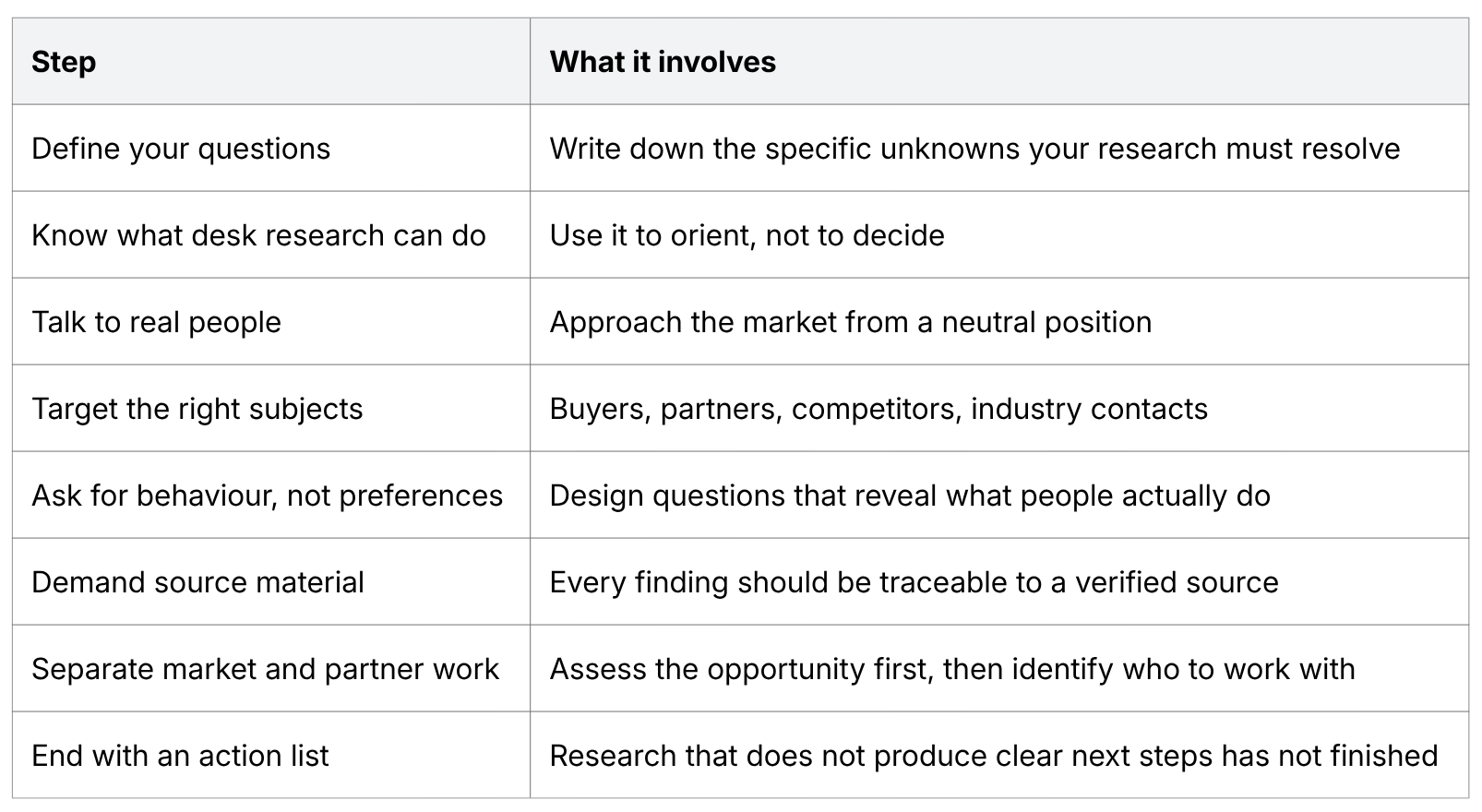
The steps at a glance
FAQ
How is market entry research different from desk research?
Desk research uses publicly available sources. Market entry research goes beyond that through direct calls, neutral interviews and primary data gathering. The two are complementary but not interchangeable. Desk research orients you; primary research tells you what is real.
How many people do you need to interview for the findings to be reliable?
It depends on the complexity of the market and the number of distinct segments being studied. For niche B2B markets, findings often stabilise after 30 to 50 interviews. Larger or more fragmented markets may require more. Your research team should be able to advise on sample size based on your specific questions.
Can we do market entry research with our own internal team?
You can gather some useful information this way. The limitation is that internal teams cannot easily approach buyers, competitors and partners from a neutral position. Once people know who you represent, they manage the conversation accordingly. Neutrality is what gets you honest answers.
What countries does Zenith Partners cover for market entry research?
Zenith Partners conducts market entry research across Singapore, Malaysia, Indonesia, Vietnam, the Philippines, Australia and several other markets in the region. Multi-country projects are structured with country-specific research feeding into a single comparative report.
Is market entry research eligible for government grants?
Yes. For Singapore-based companies, the Market Readiness Assistance (MRA) grant can cover a portion of qualifying market entry research costs for overseas expansion. Zenith Partners can advise on eligibility and scope during an initial consultation.
