
Competitive Intelligence vs Market Research: What B2B Firms in Southeast Asia Actually Need
Competitive intelligence vs market research: what you actually need before market entry
Most B2B leaders use the terms interchangeably. They say "market research" when they mean competitive intelligence. They commission one and expect the other. Then they wonder why the findings did not help them make a clear decision.
The distinction matters. Not as a point of academic precision, but because the two things answer very different questions, use different methods, and produce very different outputs.
If you are entering a new market in Southeast Asia, evaluating a partner, or trying to understand why a competitor keeps winning deals you thought were yours, you need to know which one is right for you before you spend money on it.
The simplest way to explain the difference
Market research looks outward at buyers and behaviour. Competitive intelligence looks sideways at competitors, partners and channel structures.
Market research asks: who buys this, why do they buy it, how do they decide, and how many of them are there?
Competitive intelligence asks: who else is in this space, what are they charging, who are their clients, where are they weak, and what happens if we go up against them?
Both are useful. But they are useful for different decisions. Mixing them up means you often end up with a lot of information and very little clarity.
What market research is good at
Market research is the right tool when you are trying to understand your buyer.
It helps you answer questions like:
Is there enough demand in this market to justify investment?
What do potential customers care about most?
Would they switch from their current supplier, and under what conditions?
How do they prefer to buy, and who influences the decision?
Is our pricing in the right range for this segment?
These are fundamental questions, and they are hard to answer without proper research. Gut feeling and a few conversations with friendly contacts will not give you a reliable picture.
Good market research involves real people, not just data from spreadsheets. It means speaking with target buyers directly, ideally through neutral methods so they speak honestly rather than carefully. It includes surveys, direct calls, and in some cases focus groups or observation work, depending on what you are trying to find out.
When Zenith Partners does this work, the deliverable is not a generic report. It is a specific answer to a specific question the client is trying to resolve before making a commercial decision.
What competitive intelligence is good at
Competitive intelligence is the right tool when you are trying to understand your landscape.
It helps you answer questions like:
Who is already in this market, and what are they actually selling?
How do they price their services, really, not just what is on their website?
Who are their clients, and how satisfied are those clients?
Which parts of the market are oversupplied and which are wide open?
What is our competitor doing in this region that we do not know about?
The key word there is "actually". Because the answers you find through competitive intelligence are often very different from what you would get by reading websites, press releases and brochure copy.
One thing that comes up repeatedly in real B2B markets is that companies list services they do not actually offer, or claim capabilities they cannot consistently deliver. If you are making a commercial decision based on publicly available information alone, you are probably working from a distorted picture.
Competitive intelligence goes beyond what is published. It uses direct calls, neutral research identities and mystery shopper methods to get real data: actual pricing, real client lists, genuine views on vendor satisfaction. All of that is then documented, verified and backed by evidence, not guesswork.
Why B2B firms in Southeast Asia often need both
In Southeast Asia, the two disciplines are harder to separate cleanly. That is because the markets are newer, the available data is thinner, and the buying behaviour varies sharply across countries.
A Singapore-based buyer makes decisions differently from a buyer in Jakarta, Kuala Lumpur or Ho Chi Minh City. Distribution structures are different. Trust is built differently. Price sensitivity sits in different places. And the competitive landscape changes once you cross a border.
This means that before entering a new market in the region, you often need both kinds of insight:
Market research to confirm that the buyer problem is real and the demand is there.
Competitive intelligence to understand who is already meeting that demand and whether you can realistically compete.
Commissioning only one of them can leave you with a dangerous half-picture.
The most common mistake: buying one and expecting the other
Here is how it usually goes wrong.
A company decides to enter Malaysia or Indonesia. The board approves a research budget. Someone commissions a market report from an agency. The report comes back with growth rates, sector overviews and some buyer preference data.
The commercial team reads the report and still does not know:
What the three main competitors are actually charging.
Which distributors are tied up in exclusive agreements.
Why a specific segment is harder to break into than the numbers suggest.
That information was never in the brief. The company bought market research and needed competitive intelligence as well.
The reverse happens too. A company spends on competitive intelligence, maps all the players and their pricing, and then enters a new market without understanding how local buyers actually make decisions. The product is priced right. The messaging is off. The deals do not close.
Neither type of research is a substitute for the other.
A practical test: which one do you need right now?
Ask yourself what decision you are trying to make.
If the answer is "we need to understand whether there is a market for our offer here", start with market research.
If the answer is "we know there is a market, but we do not know who we are up against or how the channel works", start with competitive intelligence.
If the answer is "we are entering a new country and we need to set our pricing, choose our partners and know what to say to buyers", you probably need both, and the sequence matters: market research first to confirm demand, competitive intelligence second to understand the landscape.
What good deliverables look like
Whether you commission market research or competitive intelligence, the output should be specific and actionable.
For market research, that means:
Real buyer quotes and stated preferences, not percentages detached from context.
A clear view of how decisions are made and who influences them.
A go or no-go recommendation, or at minimum a set of conditions under which the opportunity is viable.
For competitive intelligence, that means:
Named competitors with real pricing data, not estimated ranges.
A map of the channel: who owns which relationships, who is exclusive with whom, and where there are gaps.
Client and partner views gathered through neutral methods, with the underlying recordings and transcripts available if you want to verify them.
A named target list of accounts your sales or outsourced BD team can act on immediately.
If the deliverable cannot support a real decision in the next six months, it is too abstract.
How this connects to your BD team
Intelligence without action is expensive filing.
Once you have the research, someone has to do something with it. That is where outsourced BD fits in.
A good outsourced BD team, working from a strong competitive intelligence base, can:
Approach target accounts with a message built around real buyer pain, not generic claims.
Avoid the partners and distributors who are locked up in exclusivities.
Use pricing intelligence to frame the offer sensibly from the first conversation.
Focus calendar time on accounts that are genuinely moveable.
Without the intelligence, the BD team is guessing. With it, the outreach gets sharper, the meetings get better, and the pipeline starts to reflect real opportunities rather than hopeful activity.
A quick guide to choosing
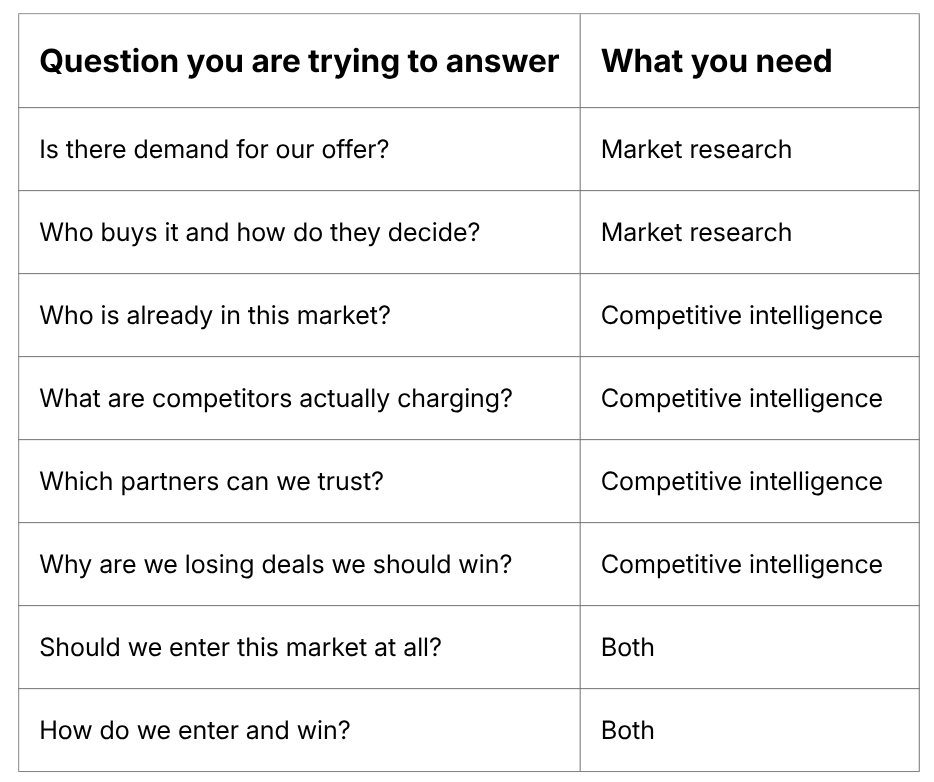
Final thought
The distinction between competitive intelligence and market research is not about which sounds more sophisticated. It is about asking the right questions before you spend.
Buying the wrong one means you get information that does not help you decide. Buying the right one means you go into your next market, partner conversation or pricing review with a clear picture of what is real.
For mid-market B2B firms in Southeast Asia, where margins on a wrong move are real and the cost of a bad partner or missed entry can run into six or seven figures, that clarity is worth the investment.
FAQ
What is the main difference between competitive intelligence and market research?
Market research focuses on buyers and demand. Competitive intelligence focuses on competitors, partners and channel dynamics. Both involve primary research, but they answer different questions.
Do I need both before entering a new market in Southeast Asia?
Usually, yes. Market research confirms that the demand is real. Competitive intelligence tells you who you are up against and how the channel works. Entering without both can leave you with a partial picture.
How long does each type of project take?
Most projects run four to eight weeks from briefing to final report. Larger scope or multi-country projects take longer. Starting early enough to leave time for action is important.
Can I use government grants to fund this type of research?
Yes. Zenith Partners' services are eligible for grant funding schemes such as Singapore's Market Readiness Assistance (MRA) grant, which can cover a portion of qualifying project costs.
