
How to Do Market Entry Research Properly: A Step-by-Step Guide for B2B Firms in Southeast Asia
How to do market entry research properly: a step-by-step guide for B2B firms
The most common mistake companies make when entering a new market is starting the research too late.
By the time a board decision has been made, a company incorporated, and a hire considered, the research has been reduced to confirming a decision already taken rather than informing it. That is the wrong order. And it leads to the wrong outcomes: a launch into a market with no real demand for your offer, a channel built on a partner who turned out to be the wrong choice, or a pricing strategy that made sense at home but looked completely out of step with local norms.
This guide is for companies that want to do it in the right order. It is a practical, step-by-step account of how good market entry research actually works, from the first question you ask to the point where your BD team can act on what you have found.
Step 1: Define the decision you are trying to make
Before you commission a single piece of research, you need to be precise about what decision the research is meant to support.
This sounds obvious. Most companies skip it.
"We want to understand the market" is not a research question. "We want to know whether there is sufficient demand for our product in the Indonesian SME sector to justify hiring a country manager this year" is a research question. The first produces a document. The second produces a decision.
The clearest way to define your research question is to ask yourself: what would have to be true for us to commit to this market? Then work backwards. What information would answer that? What would change our mind?
Good research questions tend to fall into one of two categories:
Demand validation: Is the problem we solve real and common enough in this market to justify investment?
Landscape mapping: Who is already addressing this problem, how are they doing it, and what would it take to compete?
Most serious market entry projects need both. But the sequence matters. Confirm demand before you invest in understanding competition.
Step 2: Identify what you already know and what you do not
Before you go out and gather new information, catalogue what you already have.
Most companies know more than they think. They have attended trade shows in the target country. Their sales team has had conversations with regional prospects. They have read industry reports. A colleague has a contact there. All of this is data, even if it is informal and unverified.
The value of cataloguing it is to find the gaps. You are looking for the specific questions that your current knowledge cannot answer. Not general ignorance, but precise blind spots.
A useful exercise: map out what you know with high confidence, what you believe but cannot verify, and what you simply do not know. The third category is your research agenda. The second category is where assumptions most often hide, and where the most expensive mistakes get made.
One thing that comes up consistently in real market entry work is that companies believe they know who their competitors are in a new market. They usually do not. A company that does well in Singapore may find that in Malaysia or Indonesia, the competitive set is completely different: local players with lower pricing, regional firms with established distributor relationships, or category leaders that do not even appear in global rankings.
Step 3: Choose the right research methods for your questions
Different questions need different methods. The most common failure in market entry research is using the wrong method for the question at hand.
A rough guide:
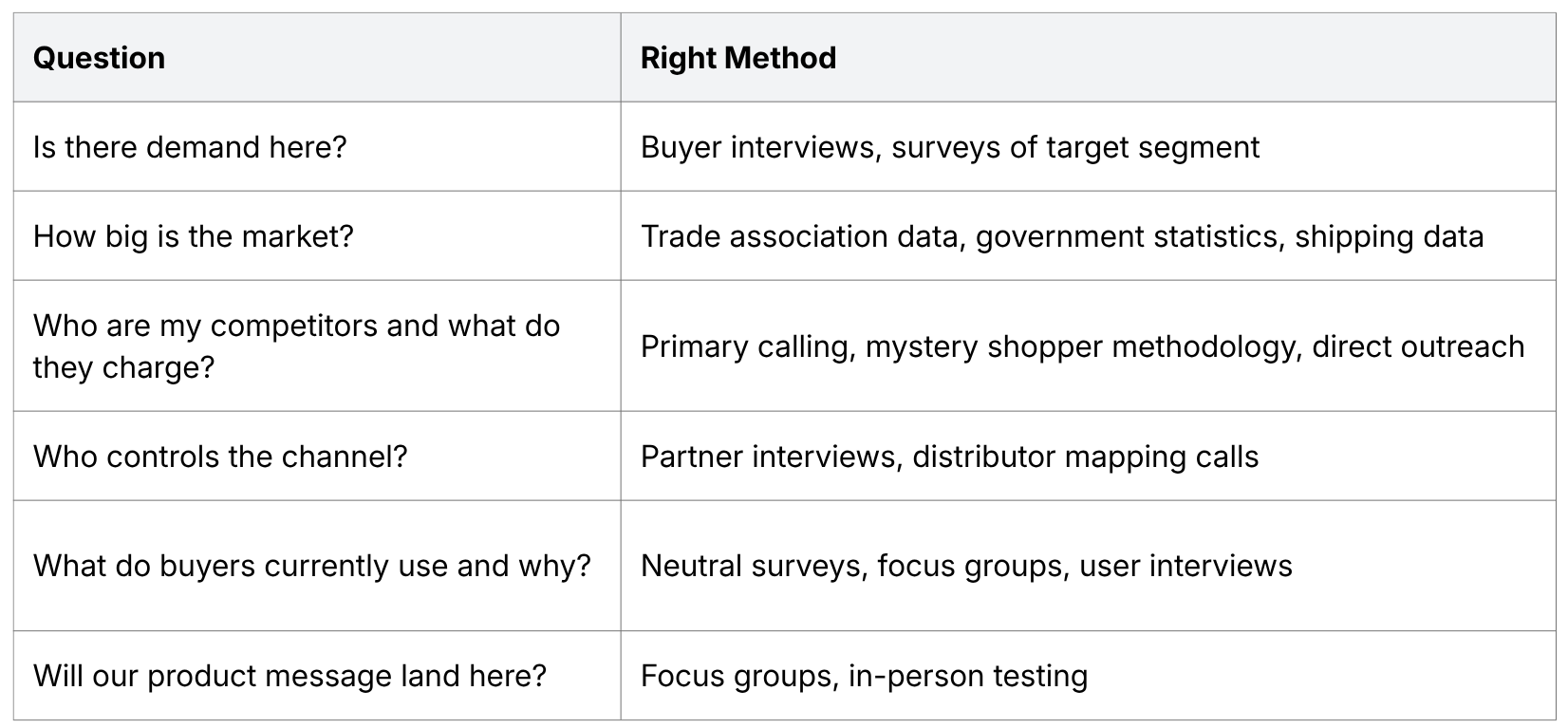
The key distinction is between desk research and primary research. Desk research — reading reports, analysing websites, reviewing press releases — is fast and cheap but tells you only what companies have chosen to publish. Primary research involves speaking to real people: buyers, competitors, distributors, and industry participants who tell you what is actually happening.
In Southeast Asian B2B markets, primary research almost always produces significantly different findings from desk research. Companies list services they do not actually deliver. Pricing on websites bears little resemblance to real negotiated rates. Competitors present themselves very differently to a potential partner than they do on a marketing page.
This is why good market entry research relies heavily on direct engagement. Not just what is published, but what the market actually does.
Step 4: Build your research subjects list
Once you know what questions you are trying to answer, you need to identify who you are going to ask.
For buyer research, this means building a list of companies that match your target profile in the new market: right industry, right size, right role for the buyer within the organisation. This list needs to be verified, not just exported from a database.
For competitive intelligence, this means mapping your competitor landscape with the same specificity. Not just the names you already know, but the full set of players operating in the target market. This often includes companies that do not have a strong web presence and would never appear in a basic search.
For channel mapping, this means identifying the distributors, resellers, agents and systems integrators who control access to your target buyer segment. In many Southeast Asian markets, the channel is the market. Knowing who the key intermediaries are, who they are already committed to, and what their priorities are is often more important than knowing the end buyer.
Build this list before you start making contact. Share it with your client or internal team and validate it: are these the right companies? Are there obvious gaps? Are there any that should be excluded? Getting the subject list right saves significant time and avoids wasted calls.
Step 5: Conduct the primary research
This is where most of the real work happens, and where the quality of a research firm shows most clearly.
Primary research in B2B markets means direct engagement with your research subjects: calls, interviews, and surveys conducted by a team that can ask the right questions without raising the guard of the person they are speaking to.
The approach matters enormously. A researcher calling a competitor and asking "what do you charge?" as a direct question will get nothing useful. The same researcher calling as a neutral potential buyer, asking about the process of becoming a client, the typical engagement model and the investment involved, will get real pricing data.
Good research calls are scripted and tested in advance. The script is built around the information you need, with questions designed to elicit honest answers rather than managed responses. Every call is recorded, with the recordings available as underlying evidence for the findings.
For buyer research, the methodology is different: a neutral survey framing, often conducted on behalf of an industry association or a market research publication, with participants incentivised to participate and questions designed not to reveal your client's commercial interest.
In both cases, the outputs are specific and traceable. Not just "competitors charge between X and Y" but "we called these six companies, spoke to these specific contacts, and this is what they told us, with the recording available for verification.
Step 6: Validate findings as you go
Good market entry research is not a one-pass process. You gather findings, bring them back to the client, validate them against what the client knows, refine the approach, and go back out to fill in gaps.
This iterative model is important for two reasons. First, the client almost always knows things that change the interpretation of the data. A finding that looks like a significant opportunity might be something the client has already tried and found did not work. A competitor that looks strong from the outside might have known internal problems that make them less of a threat than they appear.
Second, good research generates new questions. An interview with a distributor reveals that the whole channel is about to consolidate. A call to a competitor reveals that they just lost their three biggest clients. These are material findings that change what you do next, and you can only act on them if you are checking in regularly rather than waiting for a final report.
Plan for at least two check-in points during a research project: once when the initial subject list has been built and validated, and once when the first wave of findings is in and the remaining research agenda needs to be refined.
Step 7: Synthesise findings into a clear recommendation
Research that produces information without a recommendation is incomplete.
The final deliverable from a market entry project should not be a data dump. It should answer the question you started with, directly, with a recommendation supported by the evidence.
That recommendation typically takes one of three forms:
Enter this market, here is how and here is who to target first.
Enter this market, but not yet: here are the conditions that need to be true first.
Do not enter this market now: here is why, and here is where to look instead.
Each of these is a useful outcome. The third is especially valuable, even though it is the one clients least want to hear. A research process that tells you not to enter a market before you have spent six figures trying has already paid for itself.
Supporting the recommendation should be specific, actionable outputs:
A named list of target accounts with contact details and context for the first approach.
A competitor map with real pricing data, client names where possible, and notes on where each competitor is strong or weak.
A messaging guide showing how to position your offer in this market, based on what buyers actually said they care about.
Step 8: Connect the research to action
The point of market entry research is not the report. It is what happens after it.
This means handing off findings to the people who will act on them. If you have outsourced BD, the intelligence should go to that team before the first outreach call. If you have an internal sales team, the research findings should be reviewed and discussed before they start prospecting.
The research should shorten the time between your first contact with a new market and your first qualified conversation. It should eliminate the weeks your BD team would otherwise spend figuring out who to call, what to say, and how your offer compares to what the market is used to seeing.
A target list that comes out of market entry research is not just a list of companies. It is a list of companies with context: what they buy, who their current supplier is, what their pain is, and what objection they are likely to raise in the first conversation. That context is what separates a warm approach from a cold one.
How long does this take?
For most single-country B2B market entry projects, the full process takes eight to twelve weeks from brief to final deliverable. Larger scope or multi-country projects take longer.
The single biggest cause of delay is starting too late. If your board has approved market entry for Q2 and you commission research in February, you are already behind. The research needs to be complete and the BD team briefed before the commercial push starts, not during it.
A good rule: buffer two to three months between commissioning research and expecting the BD team to be working from its findings.
What good research costs
For a single-country B2B market entry study covering both demand validation and competitive landscape mapping, the typical investment range is USD 15,000 to USD 30,000 depending on scope, depth and the complexity of the target segment.
That figure needs to be measured against what it costs to get the entry wrong. A bad partner choice in a new country, a pricing strategy that is too high or too low for the local market, a channel approach that gets blocked by a competitor with existing exclusivities: any one of these can cost far more than the research that would have prevented it.
Serious market entry research is cheap insurance. The question is not whether you can afford to commission it. The question is whether you can afford not to.
FAQ
How early should I commission market entry research?
Ideally two to three months before your intended commercial launch. The research needs to be complete and acted upon before your BD team starts outreach, not after. Starting too late turns research into a retrospective exercise rather than a decision-support tool.
Can I do this research internally?
You can gather some of it internally. But internal teams face real constraints: they cannot call competitors without being recognised, they carry commercial biases that affect how they interpret what they hear, and they rarely have the bandwidth to run a systematic research programme alongside their other work. Most companies that try to do this internally end up with incomplete data and confirmation bias.
Do I need research for every country I enter?
Yes. What works in Singapore does not automatically work in Malaysia or Indonesia. The buyer behaviour is different, the channel structure is different, the competitive set is different, and the pricing norms are different. A research project for each market is the right investment.
What is the most important question to answer before entering a new market?
Whether the problem you solve is real and common enough in that specific market to justify the investment. Everything else, competitor mapping, channel analysis, pricing strategy, depends on the answer to that question being yes.
How do I know if the research is good enough to act on?
Good research produces a specific recommendation, names specific accounts, cites specific evidence for every finding, and is traceable back to the calls and conversations that generated it. If the research you receive does none of those things, it is not ready to act on.
